Apple's touchscreen MacBook Pro has an OLED display and starts at $2,899
Apple announced a touchscreen MacBook Pro on Wednesday, October 28. It starts at $2,899 in the US and uses a new tandem OLED panel that Apple calls the PROLED XDR display. Apple says it's the first Mac with touch, and pre-orders are open now ahead of deliveries on Friday, November 6.

Touch comes to the Mac
Apple says the touch sensor is built into the display panel itself rather than layered on top, to cut latency. You can swipe to scroll, pinch to zoom, drag slides from one presentation to another and double-tap a window to fill the screen. Touch works alongside the keyboard and trackpad.
Apple says many existing apps work with touch right away because macOS translates touches into clicks. Developers get updated gesture APIs, and Apple published new developer videos and resources for touch on the same day. Apple lists Microsoft's Word, Excel, PowerPoint and Outlook apps, plus Adobe Lightroom, DaVinci Resolve, Blender, Zoom and Canva among the third-party apps that will take advantage of touch later this year.
The Mac also gets the Dynamic Island from the iPhone. It sits at the top of the screen and holds Spotlight, Live Activities and Siri AI. You can also control music or accept an AirDrop request there with a tap. Apple's fine print says Spotlight only moves there if Siri AI is available and turned on, and Siri AI is in beta in macOS 27.2.
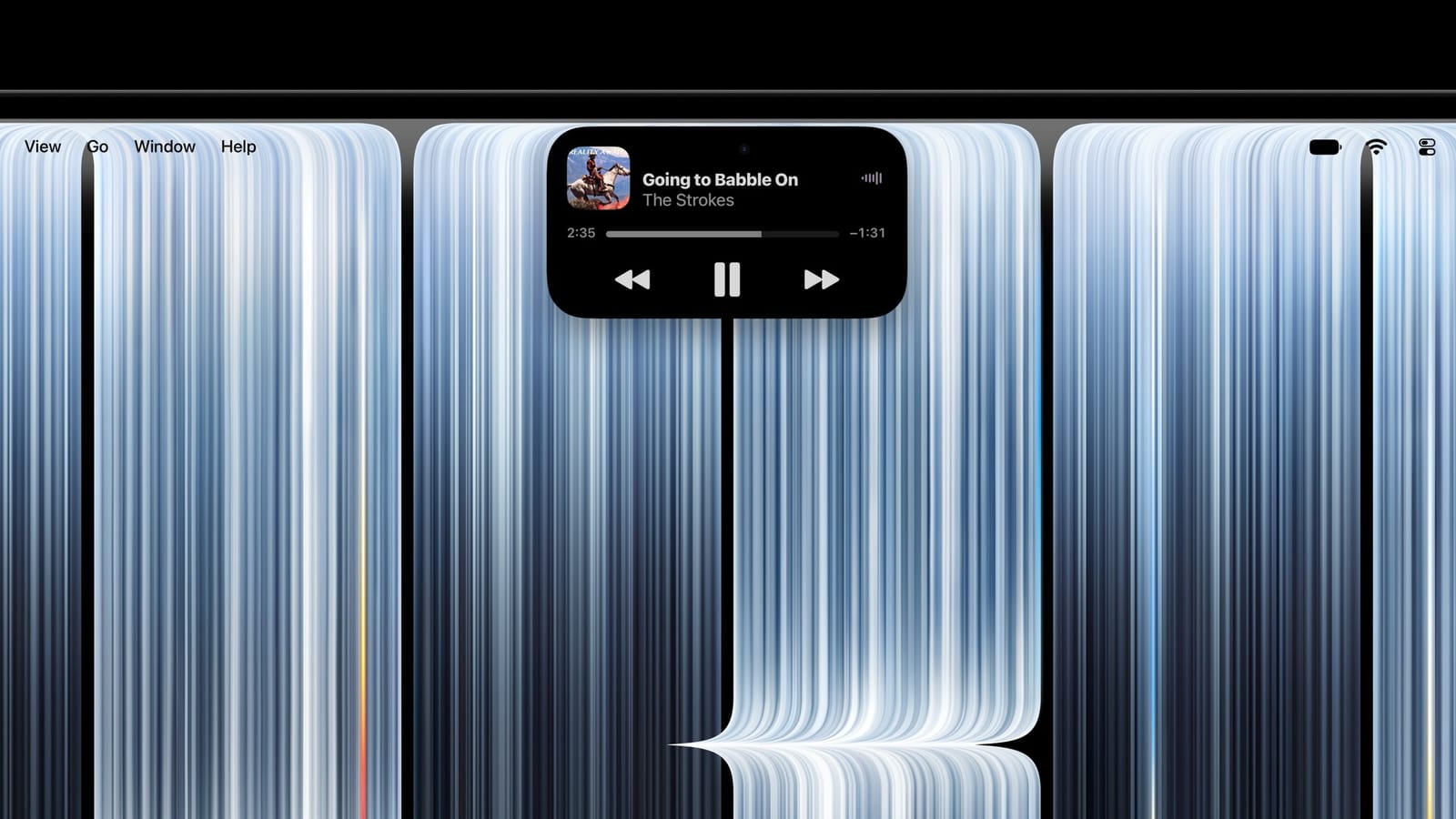
The PROLED XDR display
The panel uses two layers of self-lit OLED pixels. Apple lists up to 2,000 nits peak brightness for HDR content (and for SDR content outdoors), 1,000 nits sustained full-screen, a 10,000,000:1 contrast ratio and refresh rates from 10Hz to 120Hz. It supports the P3 and Adobe RGB wide color gamuts. A nano-texture glass option is available.
Thinner borders stretch the larger model's screen to 16.3 inches, while the smaller one measures 14.2 inches. Apple also added calibration tools, reference modes and DICOM modes for reviewing medical images. Apple says the DICOM modes are for nondiagnostic use only.
Chips, battery and design
The new models use M5 Pro and M5 Max, not the M6 chip Apple announced on Tuesday for the cheaper 14-inch MacBook Pro. The 14-inch model starts with an M5 Pro that has a 15-core CPU and a 16-core GPU, and every M5 Pro configuration starts with 24GB of unified memory and a 1TB SSD. M5 Max goes up to 128GB of memory and now up to 16TB of storage.
The 14-inch model weighs 3 pounds with M5 Pro, half a pound less than before, and the 16-inch model weighs 4 pounds with M5 Pro, 0.7 pounds less than before. Apple rates the 16-inch M5 Pro model at up to 24 hours of video streaming and the 14-inch M5 Pro model at up to 22 hours.
Both sizes have 3 Thunderbolt 5 ports, HDMI, an SDXC card slot, MagSafe 3 and a headphone jack, plus Wi-Fi 7, Bluetooth 6 and a 12MP Center Stage camera. Both come in space black and silver.
Price and availability
- 14-inch with M5 Pro: from $2,899 ($2,749 for education)
- 16-inch with M5 Pro: from $3,399 ($3,199 for education)
- 14-inch with M5 Max: from $4,499 ($4,199 for education)
- 16-inch with M5 Max: from $4,799 ($4,499 for education)
Pre-orders are open on Apple's online store and in the Apple Store app in 30 countries and regions, including the US. Deliveries and in-store availability start Friday, November 6.
What it means for you
The cheapest touchscreen model costs $900 more than the 14-inch MacBook Pro with M6, which starts at $1,999 and keeps a mini-LED display without touch. If you don't need the OLED display or touch for drawing, music or 3D work, the M6 model is the cheaper option.
Before you buy for touch alone, check whether the apps you rely on are on Apple's list of apps that will take advantage of it.